
Roof Repair in Simi Valley
Infinity Roofers handles roof repair in Simi Valley and nearby Ventura County towns: leaks, cracked or slipped tiles, damaged shingles, failed flashing, and leaks around vents, pipes and other roof penetrations. We inspect the damaged area, find where the water is actually getting in, and give you a written repair quote; if a replacement makes more sense, we tell you plainly.
To book a visit, describe the problem in the estimate form below. We are a licensed roofing contractor (CSLB license #1134192) handling residential roof repair and commercial roof repairs across Ventura County and Los Angeles County, with locations in Simi Valley, Canoga Park and Pasadena.
Thank you, we have your request
We will call you back at about your roof.
Roof leaking right now? What to do first
- Catch the water. Put down buckets and towels, and move furniture, electronics and rugs out of the drip line.
- Watch the ceiling. If drywall sags or bulges with water, keep everyone out from under it and switch off the breaker for any light fixture in that area.
- Write down what you see. Photograph the stain and the drip, note the date, and note whether it leaks in every rain or only when wind comes from one direction. That detail helps us find the source faster.
- Stay off the roof. Wet shingles and tile are slippery, and tile cracks under a person’s weight, which can turn one leak into three.
- Contact us with the estimate form on this page and tell us where the water shows up inside and what the roof is made of.
Common roof problems on Simi Valley homes
Most of Simi Valley’s houses were built between the 1960s and the 1980s. The U.S. Census Bureau’s 2024 American Community Survey puts the city’s median year built at 1980, with about two in three homes dating from 1960 to 1989. On a house that age the roof covering may have been replaced once or more, but flashing, vent pipes and the deck can be older than the shingles or tiles on top.
- Sun-worn shingles. Years of strong sun dry asphalt shingles until they curl and crack, and they shed the granules that protect them.
- Wind-lifted shingles and displaced tiles. The National Weather Service describes Santa Ana winds as strong, hot, dust-bearing winds that descend toward the coast from inland desert regions. Gusts like that loosen shingles, shift tiles and bend flashing, leaving openings around vents and other penetrations.
- Tree damage. Branches that touch the roof scrape away the surface, falling limbs crack tile, and leaves packed into valleys and gutters hold water against the roof.
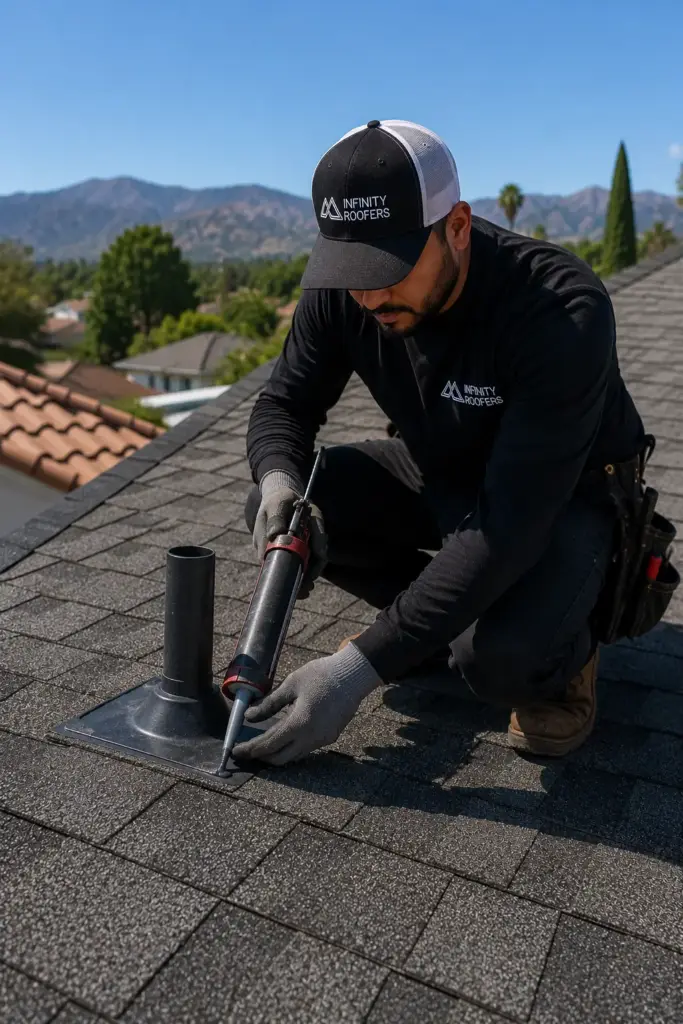
- Penetration leaks. Vents, pipes, skylights, HVAC equipment and other penetrations leak when their seals or the roofing around them deteriorate.
- Flashing problems. Flashing protects the most vulnerable joints of a roof; once it rusts, lifts or loses its seal, water finds the gap.
Why the stain on your ceiling is rarely under the hole
Water that gets past the roofing runs along the underlayment, the deck or a rafter before it drips, so the stain inside can sit several feet down-slope from the opening. A patch over the spot above the stain often misses the real entry point, which is how so many earlier repairs fail.
That is why effective roof repair starts with finding the actual source of the problem. We look at the affected area, the surrounding materials and other accessible components (penetrations, flashing at walls and chimneys, valleys, cracked tiles) before any work begins, and then explain what needs repairing and why.
Tile, shingle, metal and flat roof repairs

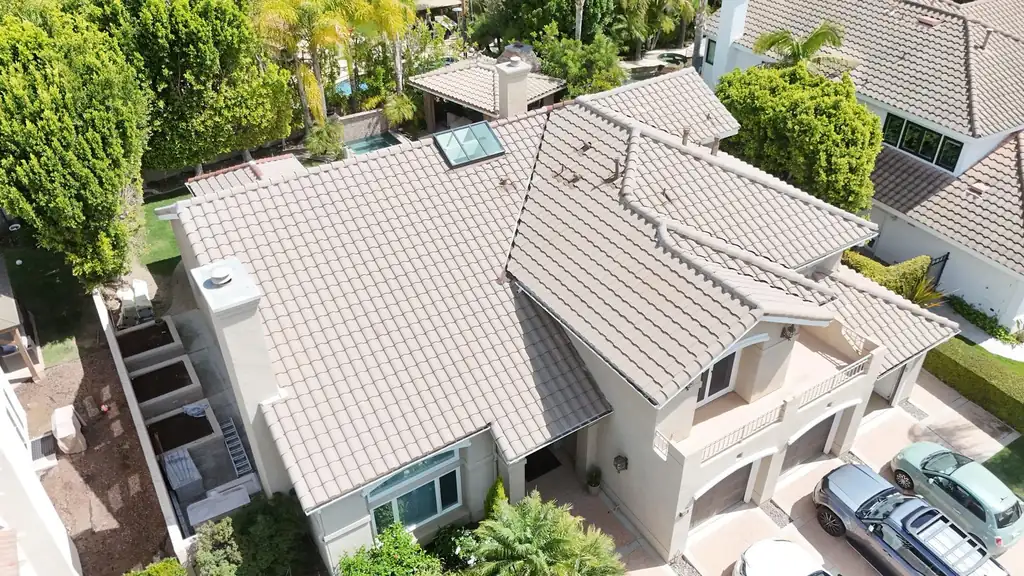
Tile roof repair
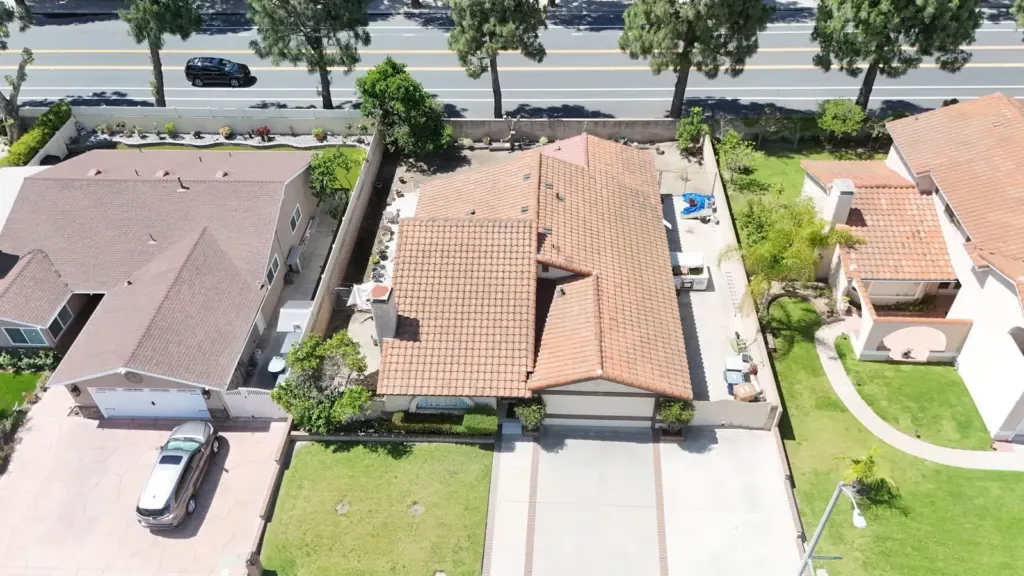
A cracked, broken or slipped tile lets water reach the underlayment below it. We replace the damaged tiles, reset the ones that have moved, and check the underlayment in that area, because on an older tile roof the layer under the tiles may be the part that has worn out.
Asphalt shingle repair
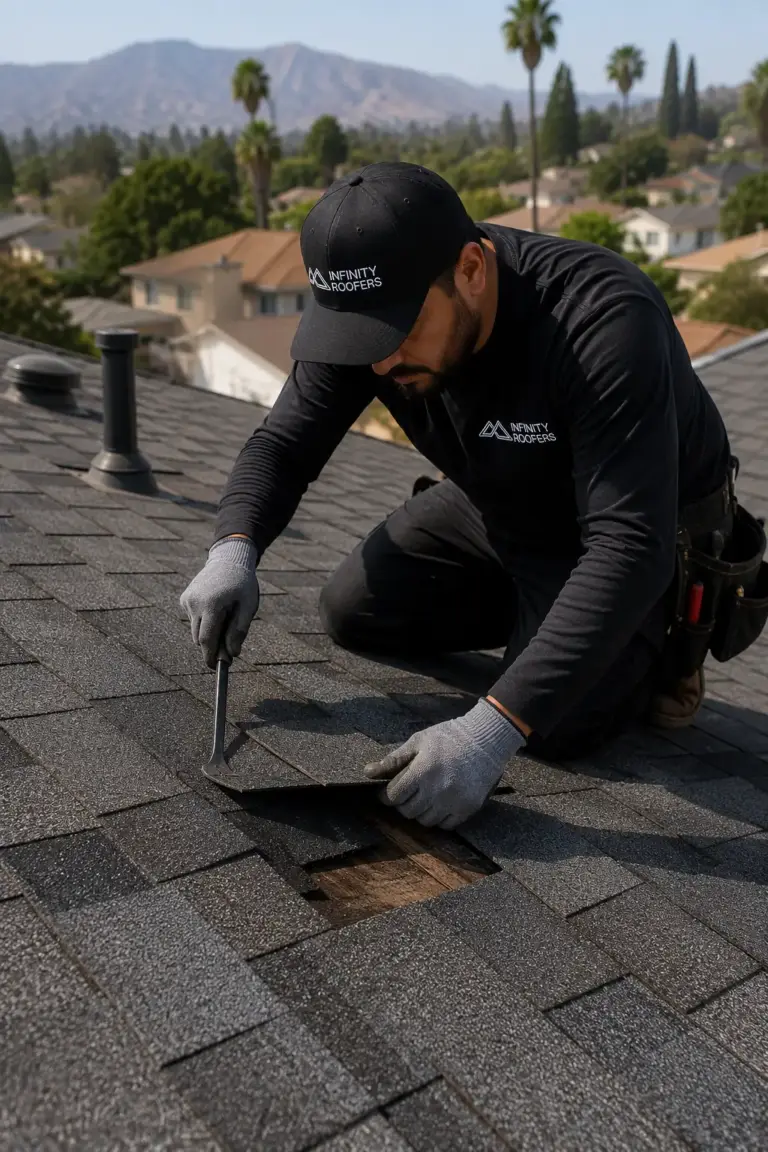
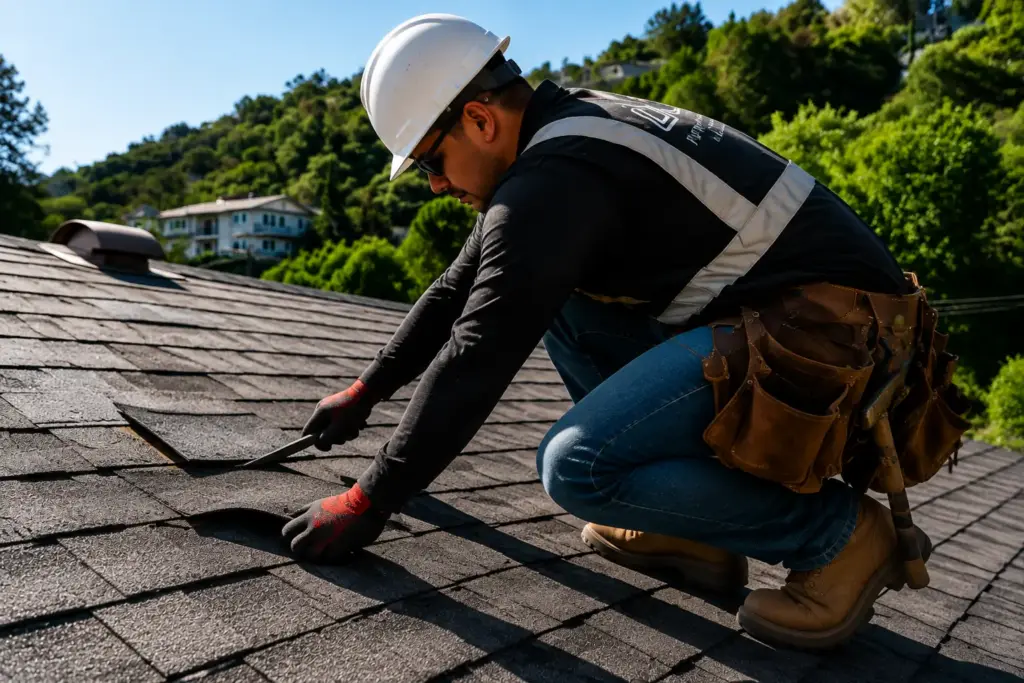
Lifted, creased, cracked or missing shingles stop the roof from shedding water. Replacing them is usually straightforward; on an older roof, an exact color match is not always possible, which is worth knowing before the repair.
Metal roof repair
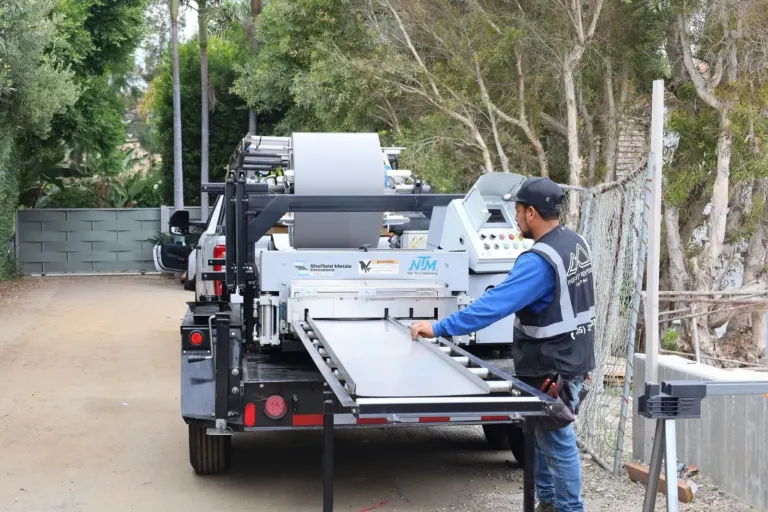
Metal roofs leak at their connection points: seams, fasteners, penetrations and flashing. We evaluate those areas and repair the ones that have opened up.
Flat roof repair
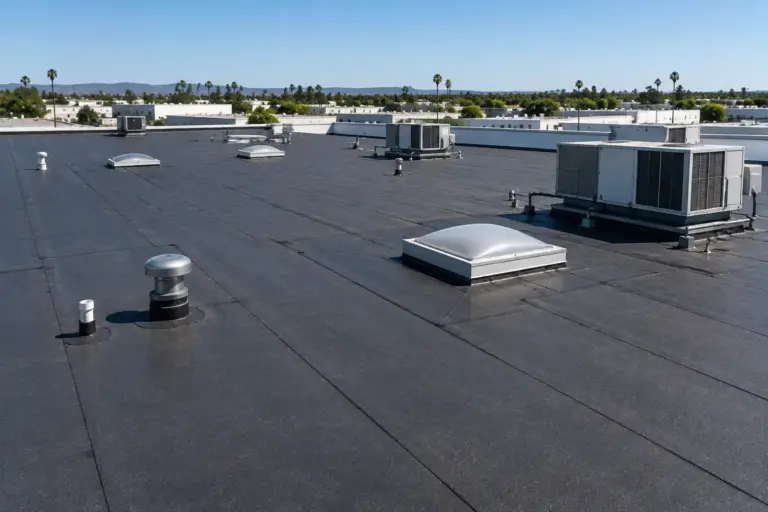
Flat and low-slope roofs need careful attention to seams, penetrations, drainage and the areas where water stands after rain. For business roofs with TPO, EPDM or modified bitumen membranes, see commercial roof repair.
Repair or replace: how we decide
| A repair fits when | Replacement is worth discussing when |
|---|---|
| The damage is limited to one area | The damage is widespread across the roof |
| The roof still has useful service life | The roof is approaching the end of its useful life |
| The roofing materials are generally in good condition | The materials are significantly deteriorated |
| The deck and underlayment remain sound | Leaks continue after previous repairs, or several areas need repair at once |
If a targeted repair is appropriate, we restore the affected area without recommending a full new roof. When the answer is replacement, we explain why and what it involves; see roof replacement in Ventura County for the materials, code rules and the process.
One code note for Simi Valley: on the State Fire Marshal’s 2025 map, about 71 percent of the city’s land area sits in a High or Very High Fire Hazard Severity Zone.
In those zones, and on any state responsibility area land, the 2025 California Residential Code (R902.1.1) applies the California Wildland-Urban Interface Code, and its section 507.1 requires every roof covering applied in a repair to be at least Class A. So the tiles or shingles used to patch a roof there must carry that rating too, and if 50 percent or more of the roof is replaced within 12 months, the whole covering must meet the rules for new construction.
Roof maintenance you can do, and what to leave to a roofer
Safe for most homeowners
- After a windy day, scan each slope from the ground with binoculars for lifted shingles, slipped tiles or branches.
- Keep gutters and downspouts clear so water leaves the roof edge instead of backing up under it.
- Trim branches that hang over or touch the roof.
- After heavy rain, look in the attic with a flashlight for damp insulation, stains on the deck, or daylight around vent pipes.
Leave to a roofer
- Walking on tile, which cracks underfoot.
- Resealing or replacing flashing at chimneys, walls and skylights.
- Any work on a steep or two-story roof.
- Caulking over a leak nobody has traced; sealant on the wrong spot hides the problem until it spreads.
Our roof repair process

- Inspect and diagnose. The repair starts with an inspection of the damaged area and the roofing around it, so we know what is causing the problem.
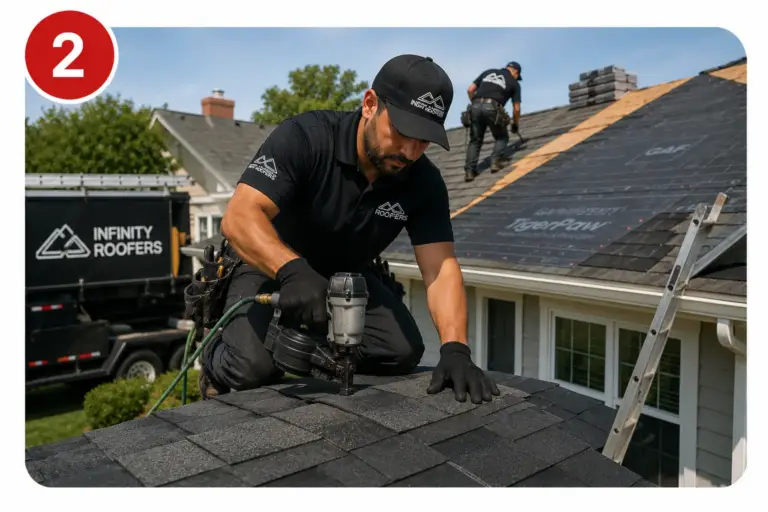
- Plan and repair. We explain the recommended repair in a written quote, then complete the work with appropriate materials.

- Review and protect. After the repair we review the finished work with you and point out any other roofing concerns that deserve attention.
What drives roof repair cost
Repair prices depend on what the inspection finds, so the number comes in your written quote. What moves it:
- Access: roof height, pitch and whether the house is two stories.
- Material: matching tile or shingles on an older roof can take sourcing.
- Size of the damage, and whether the underlayment or deck below is wet or rotted.
- Where the leak is: flashing at a chimney, wall or skylight takes more work than a few shingles in the open field of the roof.
- How many separate problems the inspection turns up.
Roof repair across Simi Valley and nearby towns
Beyond Simi Valley we repair roofs in Moorpark, Thousand Oaks, Newbury Park, Camarillo, Westlake Village, Agoura Hills and the rest of Ventura County, in the western San Fernando Valley around our Canoga Park location, and in the San Gabriel Valley around Pasadena. After wind or a fallen branch, see storm damage roof repair; for every town we cover, see service areas.
Roof leak repair questions
Why does my roof leak near the chimney, and can it be fixed without a new roof?
On a roof about 10 years old, a ceiling leak near the chimney most often points to the flashing, the metal that seals the joint between the roof and the chimney. Failed flashing is fixed with a repair, not a new roof: the flashing is replaced and the shingles or tiles next to the chimney are relaid, while the rest of the roof stays.
A newer roof can still have old flashing. Most Simi Valley homes date from the 1960s to the 1980s, so a 10-year-old roof there is usually a replacement on an older house, and the metal around the chimney is not always replaced with the roofing.
Because water can run along the deck before it shows on the ceiling, the inspection confirms the entry point first. Around a chimney it checks:
- The flashing. The step flashing along the sides, the counterflashing set into the chimney over it, and the apron across the front. Lifted or rusted metal, or a joint held only by caulk, lets water through.
- The uphill side. Leaves pile up behind a chimney and hold water against the flashing. A wide chimney needs a cricket, a small peaked section that turns water around it.
- The chimney itself. A cracked crown, open mortar joints or cracked stucco let water run down inside the chimney. That is masonry work, not a roof repair, and the inspection tells you which one you have.
- Tile roofs. The flashing and the underlayment below the tiles keep the water out, so the tiles around the chimney are lifted to reach them.
In Simi Valley’s High and Very High Fire Hazard Severity Zones, new shingles or tiles used around the chimney must be Class A (see the code note under “Repair or replace: how we decide”). And find the paperwork from the roof replacement before you pay for a repair: a 10-year-old roof may still be under the installer’s or the manufacturer’s warranty.
Is roof leak repair covered by insurance?
Generally, only when a covered event, such as strong wind or a falling limb, made the opening; a leak from age, wear or worn flashing usually is not covered. The California Department of Insurance’s claims guide says homeowners policies would generally pay for damage from rain coming through a hole in the roof when strong winds or another covered exposure in the policy caused the hole.
Its Residential Insurance Guide lists sudden and accidental water damage among the perils a homeowners policy typically covers, and water damage from seepage or leaks, wear and tear or maintenance, and neglect among the losses generally not covered.
A chimney leak that comes back with every rain because the flashing wore out falls on the wear side of that line; flashing torn loose by wind may not. Check the exclusions in your own policy, and ask your insurer whether the water damage inside is covered.
If wind or a storm opened the roof, our storm damage page explains how to handle a roof insurance claim after a windstorm, and whether homeowners insurance covers roof damage from a storm, including what to check on a FAIR Plan policy.
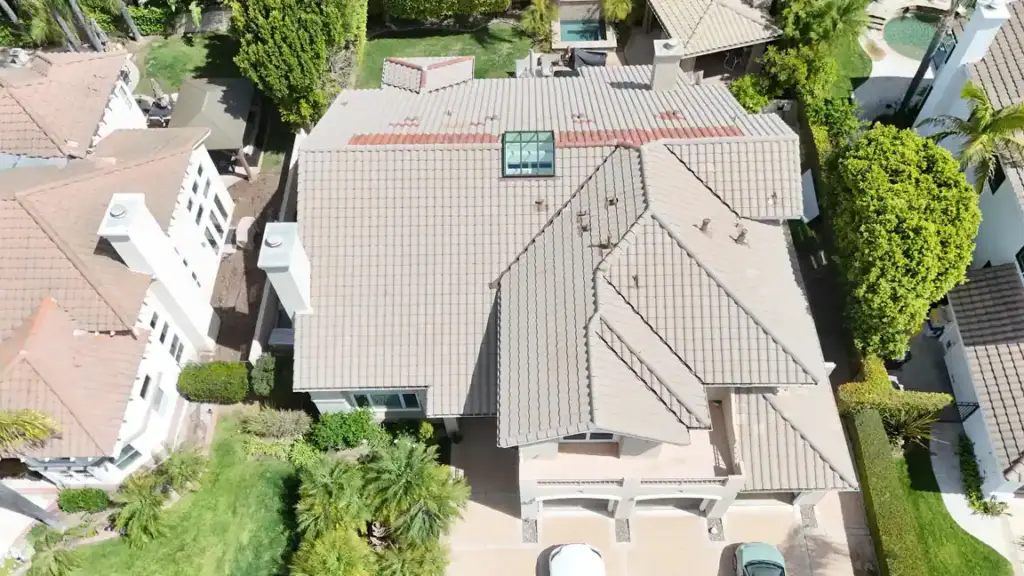
Who fixes water shooting over the gutter from a tile roof valley, a roofer or a gutter company?
Start with a roofer who works on tile, because the first thing to check is the valley flashing: the metal under the tile edges that carries the runoff of two roof slopes in one channel and controls where that stream leaves the roof.
The TRI Alliance’s Concrete and Clay Roof Tile Installation Manual (March 2024), which describes how tile valleys are built today, calls for valley flashing with a center splash diverter rib 1 inch high, and for the valley metal to extend its entire width beyond the roof edge. An older valley, or one with another metal profile the manual allows, can differ without that being the fault. When water jumps the gutter in heavy rain, a roofer checks:
- The end of the valley. Whether the metal extends beyond the roof edge, or stops short or has been bent.
- The valley metal. Its profile (a center rib or another design), and whether rust or damage has changed its shape.
- What lies in the valley. Leaves packed into the trough, and cracked or slipped tiles along it.
The tiles overlap the valley metal (by at least 4 inches in the manual’s details), so reaching it means lifting and relaying tile, which is roofing work. If the valley turns out sound, the answer may lie in the gutter at that corner, which is a gutter installer’s job. Which one it is takes an inspection to confirm. To book one, describe the overflow in the estimate form on this page.
Can a roofer just reseal a leaking exhaust vent, or does it need more work?
Sometimes. Resealing is enough only when the vent’s flashing is still sound and properly built into the roofing, and the leak is confirmed at that vent. Flashing that has rusted, lifted or bent, and worn roofing around the vent, need repair or replacement; another layer of sealant only covers them.
Confirm the source first, because the stain inside is often not below the opening (see why the stain on your ceiling is rarely under the hole). Around an exhaust vent, the inspection checks:
- How the flashing ties in. The Building America Solution Center’s guide to flashing penetrations in existing roofs (U.S. Department of Energy) says every roof penetration must be properly flashed, and that flashings around penetrations should be integrated into the roof’s water control layer: the roof covering and the underlayment beneath it. Sealant spread over the surface does not change how the flashing is built in.
- The metal. Rust, lifted edges, or bends left by wind.
- The roofing around the vent. Cracked, lifted or slipped shingles or tiles. On a tile roof, the flashing and underlayment sit below the tiles.
- The attic. Damp insulation, or stained or soft deck boards around the vent duct, which show how far the water has spread.
So the repair can be a reseal of a sound vent, new flashing with the roofing around it relaid, or replacing wet underlayment and decking as well; the inspection shows which one you need.
Book a roof repair visit
Use the contact form to reach us. Tell us where the leak or damage shows and what kind of roof you have, and we will set up the inspection and give you a written repair quote.