
Roof Replacement Permit in California: When You Need One and Who Issues It
Yes, a roof replacement permit is required in California: the state building code says no building may be altered or repaired until a permit is issued by the local building official. Your city issues it if the house is inside city limits, the county if it is not, and in Ventura County a reroof permit usually needs no plans.
Infinity Roofers Inc. is a licensed California roofing contractor (License #1134192) replacing roofs across Ventura County and Los Angeles County, with locations in Simi Valley, Canoga Park and Pasadena. Questions about a permit for your roof? Send us a message through our contact page.
Below: which office issues the permit for each town we work in, how the process runs in Ventura County, the City of Los Angeles and Pasadena, the state rules every reroof permit is checked against, and what the inspector looks at.
Do you need a permit to replace a roof in California?
For a full replacement, yes. The Contractors State License Board puts it plainly: under the California Building Standards Code, no building or structure may be erected, constructed, enlarged, altered, repaired, moved, improved, removed, converted or demolished unless a permit has first been obtained from the building official. A reroof is an alteration of the building, and Ventura County lists re-roofing among the projects it permits.
Repairs are less clear-cut. Local codes exempt some small work, and the exemptions are not the same everywhere, so ask the building department before you assume a patch is exempt.
How much of the roof is replaced also changes the rules (explained below). When more than half of the roof area is replaced, the Energy Code applies to the new roofing, and outside fire hazard zones the fire rating rule covers the entire roof covering. Inside a fire hazard zone, the Wildland-Urban Interface Code applies when 50 percent or more is replaced within 12 months, and any roofing added in a repair must be Class A.
Who issues the roofing permit for your address?
The permit comes from whichever building department has jurisdiction over the property. Ventura County Building and Safety spells it out: if the project is inside the limits of an incorporated city such as Simi Valley, Thousand Oaks, Ventura, Oxnard, Ojai, Santa Paula or Fillmore, the city issues the permit; the county issues permits only in unincorporated areas.
| Where the house is | Who issues the reroof permit |
|---|---|
| Simi Valley | City of Simi Valley, Building and Safety Division (online submittal) |
| Thousand Oaks, Moorpark, Camarillo, Oxnard, Ventura, Ojai, Santa Paula, Fillmore | That city’s building department |
| Newbury Park | Not a separate city: the City of Thousand Oaks if the address is inside its limits, otherwise Ventura County |
| Unincorporated Ventura County | Ventura County Building and Safety, offices in Ventura and Newbury Park |
| Westlake Village, Agoura Hills, Calabasas, Malibu | That city’s building department |
| Canoga Park, Woodland Hills, West Hills, Reseda and other City of Los Angeles neighborhoods | Los Angeles Department of Building and Safety (LADBS) |
| Pasadena | City of Pasadena Permit Center, 175 North Garfield Avenue |
| Altadena and other unincorporated Los Angeles County communities | Los Angeles County’s building department, not the City of Pasadena |
Each of the cities in the table has its own building department in the Contractors State License Board’s statewide list. If you are not sure your address is inside city limits, the city’s building department can confirm it from the address.
Roofing permits in Ventura County: how the process runs
Ventura County treats re-roofing as a small, single-trade job. Its Building and Safety Division issues re-roofing, window replacements and structural repairs without plumbing, electrical or mechanical work under a single-trade Building Permit rather than a combination permit. Re-roofing usually needs no plans and no plan review, and typically no clearances from other agencies.
- Speed. Applied for in person at a county permit counter, many of these small permits are approved and issued in 20 to 30 minutes. Electronic applications take slightly longer.
- Where. The county has two Building and Safety offices, in Ventura and in Newbury Park, plus an online application. Status is tracked in the county’s Citizen Access portal.
- Fees. For unincorporated addresses the county offers an online permit fee estimator; cities publish their own fee schedules.
- Code edition. The 2025 Ventura County Building Code applies to building permit applications submitted on or after January 1, 2026.
- Inspections. The owner or the licensed contractor doing the work must tell the building official when the work is ready for inspection, and work that must be inspected cannot be covered before it is approved. The county also takes inspection requests by text message.
Simi Valley
The City of Simi Valley takes permit applications online through its Customer Self Service portal. Every submittal includes either a Construction Permit Declaration, filled out by a contractor who pulls the permit, or a Property Owner’s Package, filled out by a homeowner who pulls it. The city lists residential reroof review at 2 to 3 days, and asks for the ICC report when brand-new roof tile is being installed.
Other Ventura County cities
The state code underneath is the same in every city, but each city runs its own intake. What four of them publish on their own sites:
- Thousand Oaks takes applications through TO/24, its 24-hour online system for submitting permit applications, scheduling inspections, checking status and paying.
- Moorpark takes online building permit applications through its Moorpark Self-Help Online Portal (SHOP) and accepts plan check submittals electronically.
- Camarillo moved permitting to an online portal run on OpenGov and no longer accepts paper plans; inspections can be requested online.
- Oxnard offers a Residential Permit Fast Track, a one-hour plan review meeting by appointment with no added fee, and an online city map that shows whether an address is in the city’s jurisdiction.
For Ventura, Ojai, Santa Paula and Fillmore, start on the city’s building department page before the job is scheduled.
Roofing permits in Los Angeles County: Canoga Park, Woodland Hills and Pasadena
Westlake Village, Agoura Hills, Calabasas and Malibu are Los Angeles County cities with their own building departments, as in the table. Altadena, which our Pasadena location also serves, is not part of the City of Pasadena: permits there, as in other unincorporated communities, come from Los Angeles County’s building department. The two big city departments in our area work as follows.
City of Los Angeles (LADBS)
Canoga Park, Woodland Hills and the rest of the western San Fernando Valley neighborhoods inside the City of Los Angeles are permitted by LADBS. Its express permit bulletin (P/GI 2026-003, effective January 1, 2026) lists re-roofing among permits issued with no plan check, for Class A or B roof coverings weighing less than 6 pounds per square foot over existing or new solid sheathing. The same bulletin sets three conditions worth knowing:
- A Class A roof covering is required within a Very High Fire Hazard Severity Zone.
- For a residential roof replacement over 50 percent of the roof area, the product must be a cool roof product labeled and certified by the Cool Roof Rating Council.
- Removing roof tiles, laying new underlayment and resetting the same tiles is its own express permit, and cool roof compliance is not required for it.
The e-Permit requirements add a wider fire rule: for a building inside one of the city’s designated fire districts (listed as “FBZ”, “MFD” or “VHFH”), the re-roofed portion must be an approved Class A roof covering.
LADBS’s online e-Permit covers asphalt and fiberglass composition shingles and built-up roofing; other approved coverings are permitted at an LADBS Construction Services Center. Wood shake or shingle roof coverings are not approved in the City of Los Angeles, and re-roofing over existing wood shakes is not allowed. Where solid sheathing is easy to verify, LADBS usually needs one inspection when the reroof is complete; where it cannot be verified or new sheathing goes on, there are two, the first before any underlayment or roofing is placed.
Fire zones split these neighborhoods. Point checks on CAL FIRE’s current maps put parts of the hills south of Ventura Boulevard in Woodland Hills, and the hills of West Hills and Chatsworth, in the Very High zone, while points along Sherman Way in Canoga Park and in Winnetka are outside any wildland zone. Two houses a mile apart can face different roofing rules, so the address check matters.
City of Pasadena
Pasadena issues its own permits through the Permit Center at 175 North Garfield Avenue, where applications and fees are submitted during business hours; inspections and plan review status are handled through Permit Center Online. Pasadena also has designated historic districts. The city’s Design Guidelines for Historic Districts ask owners to preserve the original form, materials, eaves and rafter tails of a historic roof, and say a specialty roofing material such as tile should be replaced with a matching material whenever feasible. If your house is in a historic district, check with the Planning Division before choosing a different roof material.
The state rules every reroof permit is checked against
Whoever issues the permit, three statewide rules shape what can go on your roof. The first two depend on where the house is and how much of the roof is replaced.
- Fire rating. Inside a Fire Hazard Severity Zone, the California Wildland-Urban Interface Code sets a Class A assembly with ember protection; outside the zones, the floor is Class C. The details follow the list.
- Energy Code. For permit applications made on or after January 1, 2026, the 2025 Energy Code (section 150.2(b)1I) sets reflectance rules for the new roofing when more than half of the roof on a single-family home is replaced, and in climate zone 9 an insulation requirement for flat roofs. Simi Valley, Thousand Oaks, Moorpark, Canoga Park and Pasadena are climate zone 9 in the Energy Commission’s ZIP code list; Oxnard, Camarillo, Ventura and Newbury Park are zone 6. Our roof replacement cost guide has the town-by-town table and the exceptions.
- Reroofing code. Under the California Residential Code, a roof replacement removes the existing layers down to the deck. A new roof over an old one (a “recover”) is not allowed over a water-soaked or deteriorated roof, over slate, clay or cement tile, or where there are already two or more layers.
The fire rule inside and outside fire hazard zones
Since January 1, 2026, the California Residential Code (R902.1.1) sends roofing on a house in a Fire Hazard Severity Zone or wildland-urban interface area to the California Wildland-Urban Interface Code. That code covers every zone in state responsibility areas and the High and Very High zones inside cities; the building department confirms whether your address is in scope. Its roofing rules:
- Class A roof assembly (section 504.2), tested and rated as a whole.
- Ember protection under tile and other profiles over a wood deck (504.2.1): a 72 lb cap sheet or a Class A-tested underlayment, bird stops at the eaves, and hip and ridge caps mudded in.
- Valleys (504.2.2): metal of at least 26 gauge over a 36-inch-wide 72 lb cap sheet.
- Replacement and repair (507.1): a roof replaced, or 50 percent or more replaced within 12 months, must meet these new-construction rules, and any roofing added in a repair must be at least Class A.
Outside the zones, the Residential Code (R902.1.2) requires at least Class C for the entire roof covering when more than 50 percent is replaced within one year, and Health and Safety Code section 13132.7 sets the statewide minimum. Local rules can be stricter. In every case the installer must give the owner a certificate of the roof covering’s fire class from the manufacturer or supplier.
If cost is the worry, our guide to the California Safe Homes grant explains where the state’s fire-safe roof program stands.
Who pulls the permit: the contractor or the homeowner?
Either can, but it should never be left vague. The Contractors State License Board says a home improvement contract should state who gets the necessary building permits, along with the work, the price, the payment schedule and the finish date. Ventura County’s permit steps include “Sign permit documents (by contractor)”, and either the owner or the licensed contractor doing the work calls for each inspection.
A homeowner can pull the permit as an owner-builder, but that comes with legal duties under Business and Professions Code section 7044, and the license board warns against “consultants” or unlicensed people who push owners into becoming owner-builders to save money. Ventura County publishes a “Considering Becoming an Owner-Builder?” handout for exactly this decision. Whoever does the work, ask for the permit number before the old roof comes off.
What does the roofing inspector check?
A reroof inspection confirms the job matches the permit and the code. LADBS publishes detailed re-roofing requirements; based on them and the state code, expect the inspector to look at:
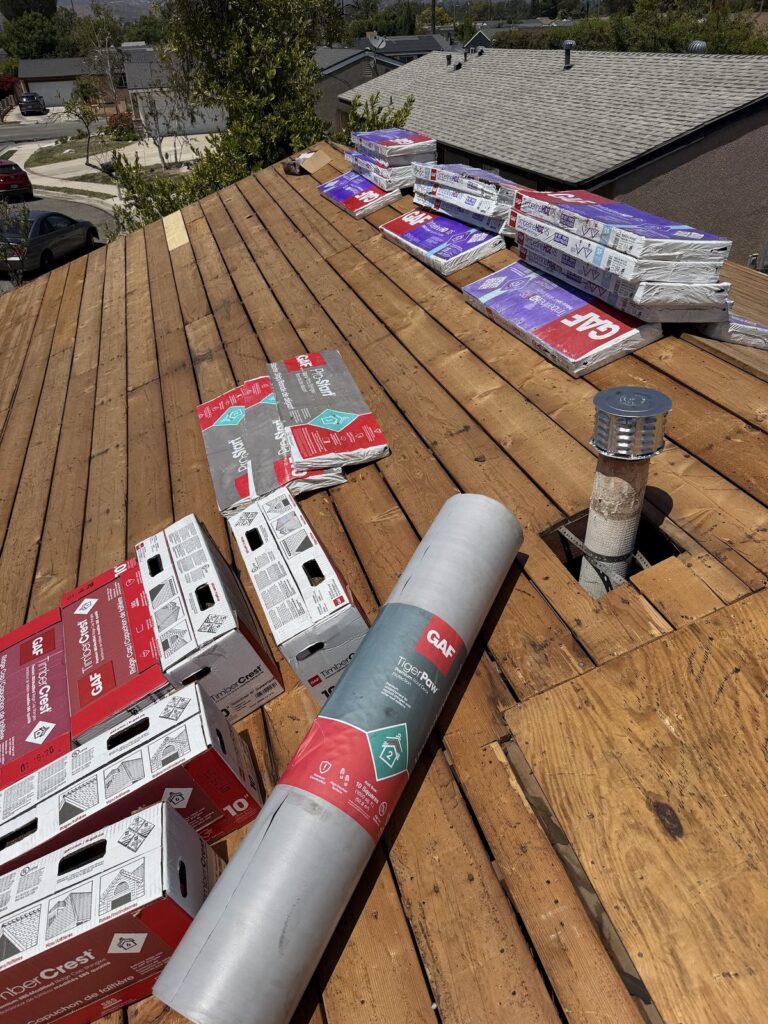
- The deck, when sheathing is new or cannot otherwise be verified, before underlayment covers it.
- The roofing product: each package of roofing material carries the label of an approved testing agency, and the fire class must match your zone.
- The ember details in a fire hazard zone: the cap sheet or Class A-tested underlayment under tile or other profiled roofing, bird stops at the eaves, mudded hip and ridge caps, and metal valleys over a cap sheet.
- The cool roof label where the Energy Code or the city requires a rated product.
- Flashing, vents and edges, which the code requires to be replaced where rusted, damaged or deteriorated.
- The finished roof at the final inspection, which closes the permit.
Keep the final inspection record and the fire class certificate with your house papers: together they show the roof was inspected and what fire class it carries.
Roofing permit questions
Do I need a permit to replace part of my roof?
Often, and the size of the area matters. In a fire hazard zone, replacing 50 percent or more of the roof within 12 months brings the roof under the new-construction rules of the Wildland-Urban Interface Code, and even a smaller repair section must be Class A. Outside the zones, replacing more than half within one year means the entire roof covering must be at least Class C. More than half also brings the new roofing under the Energy Code. Smaller repairs depend on your city’s exemptions, so ask the building department first.
How long does a roof replacement permit take?
For a simple reroof, not long. Ventura County issues many small permits at the counter in 20 to 30 minutes, Simi Valley lists residential reroof review at 2 to 3 days, and the City of Los Angeles issues re-roofing as an express permit with no plan check. A historic district review in Pasadena or a structural question can add time.
How much does a roofing permit cost?
Fees are set by each city and, for unincorporated addresses, by the county. Ventura County’s online fee estimator covers unincorporated addresses; for a city address, use that city’s fee schedule or ask your roofer to show the fee on the estimate.
Does a permit cover laying a new roof over the old one?
A recover still needs the reroof permit, and it is only allowed where the code permits it: not over water-soaked or deteriorated roofing, not over slate, clay or cement tile, and not where two or more layers already exist. In the City of Los Angeles, re-roofing over existing wood shakes is not allowed at all.
Sources
- Contractors State License Board, Do I need a building permit for my project? (with the statewide list of city and county building departments), contracts and binding agreements and owner-builder risks (read October 3, 2026).
- Ventura County Building and Safety, permit FAQ, permit types, permit process and inspections (read October 3, 2026).
- City of Simi Valley, online permit submittal instructions (read October 3, 2026).
- City of Thousand Oaks, TO/24; City of Moorpark, Building & Safety; City of Camarillo, Building & Safety; City of Oxnard, Building & Engineering (read October 3, 2026).
- Los Angeles Department of Building and Safety, Information Bulletin P/GI 2026-003, Express Permits (No Plan Check Required), revised March 27, 2026, and the e-Permit re-roofing requirements, via dbs.lacity.gov (read October 3, 2026).
- City of Pasadena, Apply for Permit and design guidelines, including the Design Guidelines for Historic Districts (read October 3, 2026).
- California Health and Safety Code section 13132.7; 2025 California Residential Code sections R902.1.1, R902.1.2 and R908; 2025 California Wildland-Urban Interface Code sections 504.2, 504.2.1, 504.2.2 and 507.1 and section 1.1.2; California Energy Commission 2025 Energy Code and climate zones by ZIP code (read October 3, 2026).
- Office of the State Fire Marshal, fire hazard severity zone viewer (read October 3, 2026).
Planning a replacement in Simi Valley, anywhere in Ventura County, the western San Fernando Valley or the Pasadena area? Contact us, read how a roof replacement runs from inspection to final walkthrough, or see where we work.